
Why Small Retaining Wall Projects Are Hard to Get Quoted
Small retaining wall projects are often hard to get quoted because setup and engineering costs do not shrink proportionally with wall size. Here's why, and what to expect.
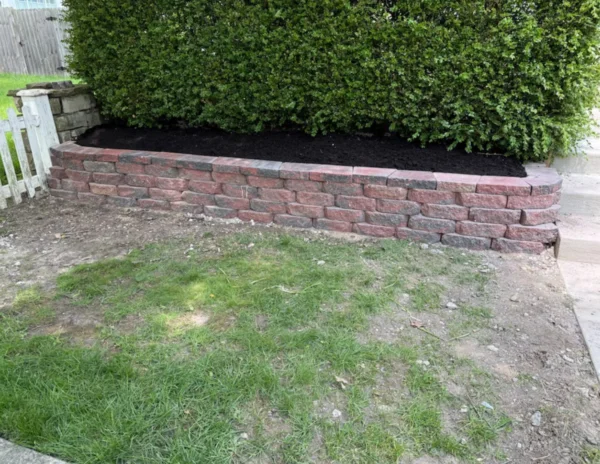
Small retaining wall projects are often harder to get a contractor to quote quickly than larger ones, mostly because the fixed costs of excavation, base preparation, and drainage do not scale down proportionally with a shorter wall. A 15-foot wall can involve nearly the same setup effort as a 40-foot one.
Homeowners with a small problem area, like a short section eroding near a driveway or a low garden bed edge, are sometimes surprised that a small job is not automatically a small quote.
This post explains what drives cost on smaller retaining wall projects and why some contractors are hesitant to take them on at all.
Why a short wall isn't just a smaller version of a big one
Building any retaining wall involves excavating a trench for the base, compacting a gravel base course, installing drainage, and setting the first course level before stacking the rest. That setup work is largely the same whether the wall is 10 feet long or 50 feet long.
Mobilizing equipment, hauling in base material, and hauling out excavated soil also involve similar logistics regardless of the wall's total length. A short wall does not need a fraction of a truckload; it often needs close to the same minimum delivery as a longer one.
This is why the price per linear foot on a small wall often looks higher than what you might have seen quoted for a much longer wall elsewhere. The fixed costs are just spread over less wall.
Drainage doesn't get to be an afterthought just because the wall is short
Even a short retaining wall needs proper drainage behind it, typically gravel backfill and sometimes a perforated pipe, to prevent water pressure from building up and pushing the wall out over time. Skipping this step on a small wall to save cost is one of the most common causes of early failure.
We cover this in more detail in our post on retaining wall drainage, but the short version is that drainage is not optional based on wall size. A poorly drained small wall can fail just as surely as a poorly drained large one.
This is part of why a proper small wall quote does not look dramatically cheaper than a mid-sized one. The drainage work is largely non-negotiable regardless of scale.
Why some contractors are slower to respond to small jobs
Larger retaining wall projects generally have a better ratio of revenue to scheduling and mobilization effort, which means some contractors prioritize them over small jobs when their schedule is full. This is not unique to retaining walls, and it is a common dynamic across the hardscape trade generally.
It is worth being upfront about the small scope of your project when requesting quotes so contractors can be honest about whether it fits their scheduling, rather than getting a slow or non-committal response.
If a wall is genuinely small, like a short section along a bed edge, it can sometimes be bundled with other planned yard work, such as a landscape design project, to make the overall job more attractive to schedule.

Why wall height matters more than length for engineering requirements
Wall height, not length, is the bigger factor in whether a project needs engineering review or a building permit. A short wall that is also tall, for example holding back a steep drop near a foundation, can trigger more requirements than a long, low wall along a flat bed edge.
We discuss the specific permit thresholds in our post on retaining wall permits in Ohio and Michigan, since requirements vary depending on your municipality and the wall's exact height.
This means a small wall in terms of footprint can still involve more design consideration than its size might suggest, if it is also a tall wall relative to the grade it is holding back.
Ways to make a small wall project easier to schedule and price
If you have a small retaining wall need, it helps to be flexible on timing, since a contractor may be able to fit a short job in between larger scheduled projects rather than as a standalone priority.
Bundling the wall with other work, like new landscaping, mulch, or a drainage correction elsewhere on the property, can also make the overall project more worth scheduling as a combined visit.
Being clear about your budget expectations upfront helps avoid a mismatch, since a small wall quote that reflects real setup and drainage costs may be higher per foot than you initially expected.
- Be upfront about project size and flexible on scheduling timing
- Consider bundling with other planned yard work
- Do not skip drainage to cut cost on a small wall
- Ask whether wall height triggers any permit requirements before finalizing plans
When a small wall is genuinely a quick, low-cost fix
Not every small wall situation is complicated. A very short, low retaining edge, sometimes just a foot or two of height difference along a garden bed, can be a straightforward and reasonably priced addition, especially if it does not involve significant excavation or drainage complexity.
The distinction usually comes down to how much soil is actually being retained and how much water pressure is expected behind the wall over time, not just the visible length of the wall itself.
A site visit is the most reliable way to know which category your project falls into, since photos alone do not always convey grade and soil conditions accurately.
Frequently asked questions
Why does my small retaining wall cost more per foot than a big one I saw quoted elsewhere?
Fixed costs like excavation setup, base preparation, and drainage do not shrink proportionally with wall length, so the per-foot cost on a short wall is often higher than on a longer wall.
Can I skip drainage on a small wall to save money?
We do not recommend it. Poor drainage is one of the most common causes of wall failure regardless of wall size, and it is not something to cut corners on even for a short section.
Why is it hard to get contractors to respond to a small wall request?
Some contractors prioritize larger projects when their schedule is full, since small jobs have a less favorable ratio of revenue to setup effort. Being upfront about project size can help set expectations early.
Does a short wall still need a permit?
It depends on the wall's height, not its length. Height is generally the bigger factor in permit requirements, so a short but tall wall may need more review than a long, low one.
The bottom line
- Small walls involve much of the same fixed setup cost as larger walls, so per-foot pricing is often higher.
- Drainage is not optional on a small wall and should not be skipped to save cost.
- Being flexible on scheduling or bundling with other yard work can make a small project easier to get scheduled.
- Wall height, not length, is the bigger factor in permit and engineering requirements.
- A site visit is the most reliable way to know what category your specific project falls into.
Have a small retaining wall project on your property
We are happy to look at short wall sections alongside other yard work to find an efficient way to schedule it.
Explore retaining walls