
Retaining Wall Block Colors: Matching Your House and Hardscape
Retaining wall block colors should relate to your house siding, existing hardscape, and mulch, not be picked in isolation. Here's how to choose one that lasts visually.
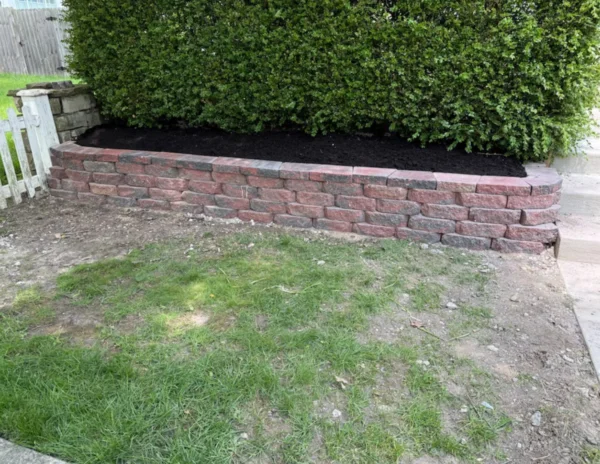
Retaining wall block colors work best when they're chosen against your actual siding, roof, and existing hardscape, not picked from a sample board in a showroom. A block that looks great in a supplier's display often reads completely differently sitting against brick, vinyl siding, or a driveway.
This is one of the more common regrets we hear about after a wall goes in. The wall itself is structurally fine, but the color feels off, too gray against a warm-toned house, or too busy next to existing pavers.
A little planning before ordering block prevents most of that.
Why does block color matter this much?
A retaining wall is one of the largest continuous surfaces in a yard, often more visible than the house foundation itself depending on placement. Get the tone wrong and it competes with the house instead of supporting it.
Unlike paint, you can't easily change block color later. Once a wall is built, you're living with that color choice for as long as the wall stands, so it's worth more consideration than most people give it.
How do you match block to your house?
Start with your siding and roof, since those are the fixed elements you're building around. Warm-toned homes with tan brick, beige vinyl, or warm-colored roofing generally look best with tan, buff, or sand-colored block.
Cooler homes with gray or blue-gray siding, or roofing with cool undertones, tend to pair better with charcoal, gray, or slate-toned block. Mixing warm block against a cool house, or vice versa, is the most common mismatch we see.
- Warm siding/roof: tan, buff, sand, or brown-blend block
- Cool siding/roof: charcoal, gray, or slate-blend block
- Brick homes: pull a color from the brick itself, not just the mortar
- Neutral homes: a blended multi-tone block gives more flexibility
What about matching existing hardscape and mulch?
If you already have a paver patio, walkway, or driveway, the wall doesn't need to match it exactly, but it should relate to it. A wall in a completely different color family than nearby pavers can make the yard look like two unrelated projects were stitched together.
Mulch color matters more than people expect too. Dark brown or black mulch against a light tan wall creates strong contrast that can look intentional or busy depending on execution. If you're not sure, a blended block that includes both light and dark tones gives more room to work with either mulch choice later.
Should you choose a solid color or a blend?
Blended block, meaning block with two or three tones mixed into each unit, tends to age better visually than a single flat color. Dirt, mineral deposits, and efflorescence show up less obviously on a blend than on a solid charcoal or solid tan block.
Solid colors can look sharp when new, especially in darker tones, but they show wear and staining faster, particularly at grade level where soil splashes during rain. If low maintenance appearance matters to you, lean toward a blend.
How do you actually test a color before committing?
Get physical samples, not just photos or a catalog page, and set them against your house in the actual location where the wall will go. Colors shift dramatically between a showroom's indoor lighting and outdoor daylight, and even more between morning and evening light.
Look at the samples at different times of day for at least a day or two if you can. A tan that looks warm and pleasant at noon can look washed out and pale in overcast morning light.
Does lighting change how the color reads at night?
It does, and this is worth planning for if you're also adding landscape lighting along the wall. Warm-white LED fixtures bring out the warm undertones in tan and buff block, while a cooler LED temperature can make gray block look almost blue at night.
If you already know you want the wall lit, test your block sample under the same color temperature bulb you plan to use, not under a showroom's fluorescent lighting.
Frequently asked questions
Can you paint or stain retaining wall block later if you don't like the color?
It's possible with masonry stain, but it's an added maintenance step and doesn't always penetrate evenly on all block types. It's far easier to get the color right at the outset than to correct it afterward.
Does block color affect price?
Some specialty colors and finishes cost more than standard tan or gray options, since they're less commonly stocked. Your contractor or supplier can tell you what's readily available versus special order.
Should the wall match the house exactly or just complement it?
Complement, not match exactly. An exact match can look flat, while a related but distinct tone gives the wall its own presence while still feeling coordinated with the house.
What if my house has multiple colors, like a brick base and vinyl upper?
Pull your reference tone from whichever material sits closest to grade, usually the brick or foundation material, since that's what the wall will visually sit near.
The bottom line
- Choose block color against your actual siding and roof, not a showroom sample alone
- Warm homes generally pair with tan/buff block, cool homes with gray/charcoal
- Blended multi-tone block hides staining and wear better than solid colors
- Test samples outdoors at different times of day before ordering
- Consider how your planned lighting's color temperature will affect the block at night
Not sure which block color fits your house?
We bring samples to your property so you can see them against your actual siding and hardscape before committing to a wall design.
Explore retaining walls