
Pond Filtration Sizing: Why Most DIY Ponds Struggle
Pond filtration sizing based on pond volume and fish load, not just what came in a kit, is why most DIY ponds struggle with algae and cloudy water. Here's how sizing actually works.
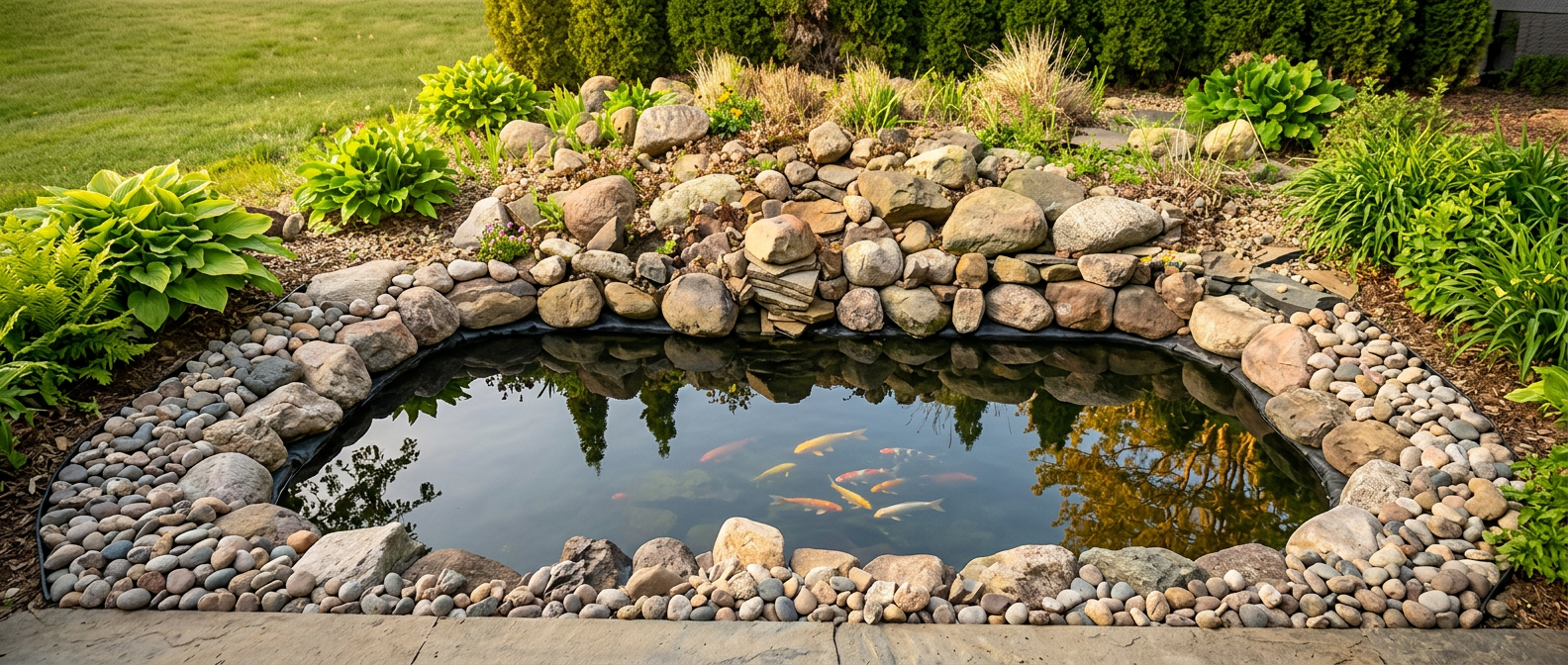
Pond filtration sizing depends on total water volume and how many fish are in it, not just whatever pump and filter came bundled in a kit. This is the single biggest reason DIY ponds struggle with algae, cloudy water, and stressed fish even when the owner is cleaning it regularly.
Kit filters are usually sized for an empty pond with no fish, which almost nobody actually has for long. Add koi or goldfish, and the bioload quickly outpaces what a starter kit filter can process.
Here's how filtration sizing actually works and where most setups fall short.
Why does a kit filter usually fall short?
Most pond kits are sized around pond volume alone, assuming little to no fish load, since that's the easiest number to put on a box. The moment you add koi or a handful of goldfish, and especially once they grow over a season or two, the actual biological demand on the filter increases well beyond what the kit was designed for.
This isn't a manufacturing flaw so much as a mismatch between what the kit assumes and what most pond owners actually do, which is stock fish shortly after building the pond.
How do you actually calculate the right filter size?
Start with total pond volume in gallons, factoring in depth variation, not just surface area times an average depth guess. From there, filtration is typically sized to turn over the full volume of the pond within a set number of hours, with koi ponds needing faster turnover than simple goldfish or water garden setups because koi produce more waste.
Fish load adds another layer. A pond stocked heavily with koi needs meaningfully more biological filtration capacity than the same size pond with just a few small goldfish, since biological filters process waste, not water clarity directly.
- Calculate true volume, not just surface area estimates
- Size for full turnover within a set number of hours based on pond type
- Increase biological capacity for koi versus goldfish-only stocking
- Account for future fish growth, not just current size
Mechanical vs. biological filtration: why you need both
Mechanical filtration removes physical debris, leaves, fish waste particles, uneaten food, before it breaks down in the water. Biological filtration relies on beneficial bacteria colonizing filter media to convert dissolved waste, mainly ammonia, into less harmful compounds.
A pond with strong mechanical filtration but weak biological capacity can look clear while still having poor water chemistry that stresses fish. A pond with strong biological filtration but weak mechanical filtration often looks cloudy or debris-filled even though the underlying chemistry is fine. You need both working together.
What does undersized filtration actually look like?
It rarely shows up immediately. A new pond with small fish often looks great for the first season, which is exactly why the problem gets missed. As fish grow and the bioload increases, the same filter starts falling behind, and symptoms creep in gradually: slightly cloudier water, more frequent algae, fish that seem a bit more sluggish.
By the time it's an obvious problem, most owners have already tried more frequent cleanings without understanding why they're not fixing it. That's the moment to look at filtration capacity specifically rather than just cleaning more often.
Is upgrading filtration cheaper than a full pond rebuild?
In most cases, yes. If the liner and basic structure are sound, upgrading to a properly sized biological filter and pump is a targeted fix rather than starting over. This is one of the more common outcomes when we evaluate a pond someone assumed needed a full rebuild.
It's worth having pond volume and fish load assessed together rather than guessing, since both factors compound each other. Our ponds work includes this kind of evaluation as a starting point before recommending any bigger changes.
Frequently asked questions
How do I know my pond's actual volume?
For irregular shapes, breaking the pond into rough sections and calculating each separately gives a more accurate estimate than a single average depth guess across the whole pond. A pond professional can also measure this more precisely on site.
Can I just add a second pump instead of upgrading the filter?
More flow without more biological media capacity often just moves the same water through the filter faster without processing more waste. Both flow rate and media capacity need to scale together.
How many koi is too many for a small pond?
This depends heavily on pond volume and filtration capacity rather than a fixed number, but overstocking is one of the most common causes of chronic water quality problems in backyard ponds.
Will upgrading filtration fix an existing algae problem right away?
It usually improves things over several weeks as beneficial bacteria establish in the new media, rather than overnight. Patience during that startup period matters as much as the upgrade itself.
The bottom line
- Kit filters are often sized for an empty pond, not one with growing fish
- Filtration sizing should account for both total volume and fish load
- Mechanical and biological filtration solve different problems and both matter
- Undersized filtration symptoms build gradually, not all at once
- Upgrading filtration is usually cheaper than a full rebuild if the liner is sound
Dealing with algae or cloudy water no matter how often you clean?
We'll assess your pond's actual volume and fish load against your current filtration and tell you honestly what needs to change.
Explore pond services