Barn and Rural Property Lighting Around Genoa and Pemberville
Rural outdoor lighting for barns and larger properties around Genoa and Pemberville covers different ground than a typical suburban lighting plan.
Rural outdoor lighting around Genoa and Pemberville covers a different set of needs than a typical suburban yard, since properties out here tend to be larger, often include barns or outbuildings, and sit further from streetlights or neighboring light sources.
That extra distance and darkness can be an advantage for visibility of the night sky, but it also means practical lighting for a driveway, barn, or work area matters more than it might in a tightly packed subdivision.
This post covers what to think through for rural property lighting, from barns to long driveways to the house itself.
What makes rural lighting different from suburban lighting
A suburban yard usually has one central focus: the house and its immediate landscaping. Rural properties around Genoa and Pemberville often have multiple structures spread across more acreage, including a barn, a shed, or other outbuildings that need their own lighting consideration separate from the house.
Distance also plays a bigger role. A driveway that runs several hundred feet from the road to the house needs a different lighting approach than a forty-foot suburban driveway, both for safety and for practicality getting equipment and vehicles around at night.
None of this makes rural lighting harder, it just means the plan usually covers more ground and more distinct zones than a typical residential lighting project.
Lighting barns and outbuildings for actual use
Barn lighting tends to be more functional than decorative, focused on visibility for chores, equipment access, and general safety around a working structure. Overhead or wall-mounted fixtures with broad, even coverage usually matter more here than accent lighting.
Entry points, especially large barn doors or equipment bays, benefit from fixtures bright enough to see clearly while loading, unloading, or handling animals after dark.
This is a different design conversation than a landscape lighting consultation focused on a home's curb appeal, though both can be part of the same overall property plan.
Driveway and approach lighting on longer rural lots
A long rural driveway benefits from lighting that marks the path clearly without requiring a fixture every few feet, which would be both impractical and expensive to run power to across hundreds of feet of open ground.
Spaced path or bollard-style lighting at reasonable intervals, combined with a stronger fixture near the road entrance for visibility from a distance, usually covers a long driveway well without excessive fixture count.
Power and wire routing also need more planning on a longer run, since voltage drop becomes more of a factor over greater distances than it would on a short suburban driveway.
- Space path or bollard lighting at reasonable intervals rather than densely
- Add a stronger fixture near the road entrance for visibility from a distance
- Plan wire runs and transformer placement carefully to account for voltage drop over distance
- Prioritize barn entry points and equipment areas over decorative accents
Preserving rural darkness while still lighting what matters
One advantage of a rural property is genuine darkness at night, which is worth preserving rather than overwhelming with unnecessary floodlighting. Excessive light around a rural property can wash out the night sky view that is part of what makes living out here appealing in the first place.
Targeted, purposeful lighting at the house, barn, and driveway covers practical needs without lighting up the whole property indiscriminately.
The International Dark-Sky Association has useful general guidance on shielded fixtures and downward-facing lighting that reduces sky glow while still providing the light you actually need on the ground.
Permanent lighting on farmhouses and rural homes
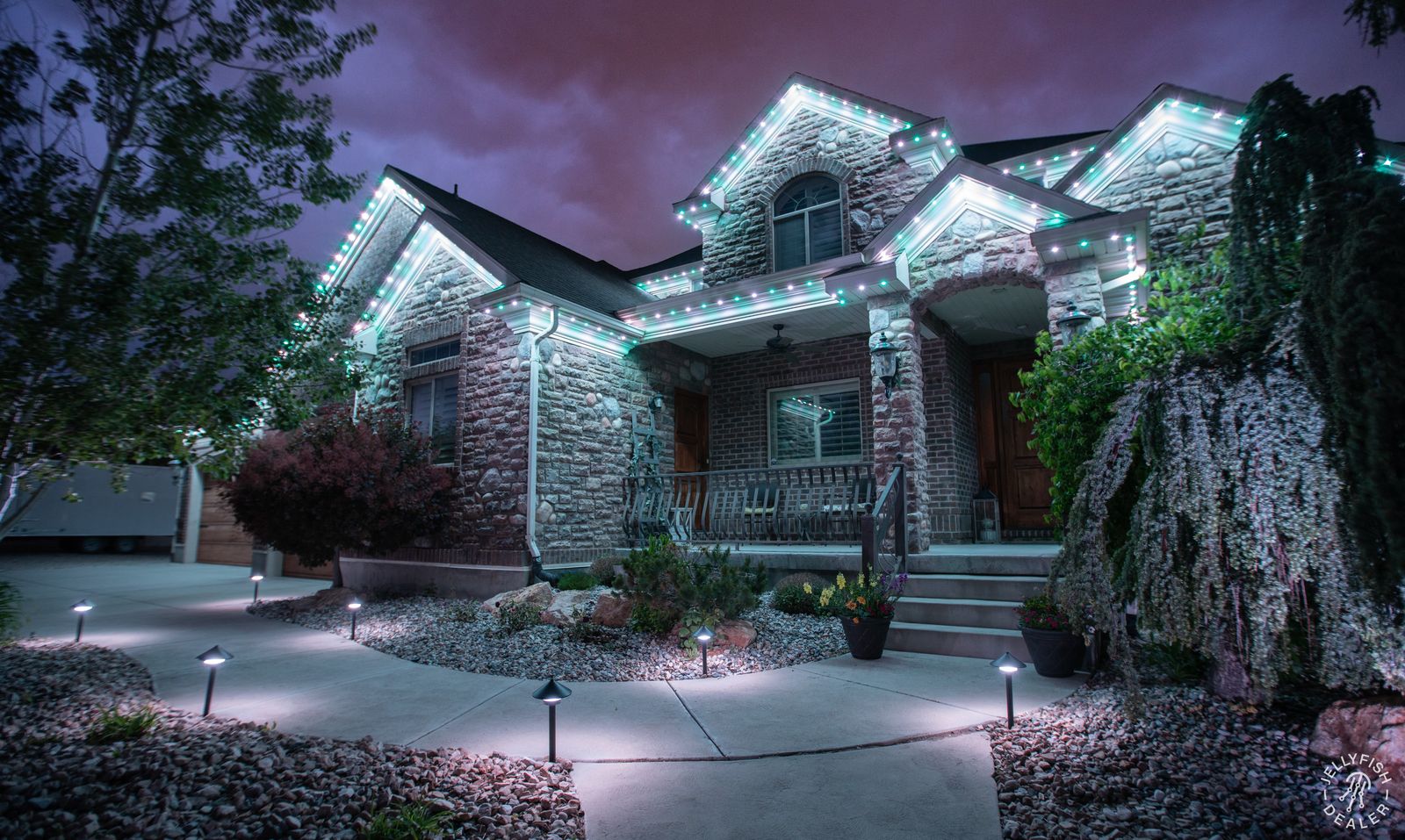
Permanent roofline lighting works well on farmhouses and rural homes just as it does on suburban properties, outlining the structure and adding visibility from a distance across open land. This can be especially useful on properties set back far from the road, where the house itself might not be easily visible otherwise at night.
The Jellyfish system installs the same way regardless of setting, though rural homes sometimes have longer rooflines or additional structures like a wraparound porch that affect the total project scope.
For rural properties, we often discuss whether to extend permanent lighting to a porch or an attached structure in addition to the main roofline, since these homes frequently have more architectural elements to consider than a standard suburban house.
Planning a lighting project across a larger property
Because rural properties often need lighting in multiple zones, it helps to prioritize during the planning conversation rather than trying to light everything at once. Some homeowners start with the house and driveway entrance, then add barn or outbuilding lighting in a later phase.
Others prioritize the working areas first, since barn and equipment lighting has a more immediate practical impact on daily use of the property.
Either sequencing works, and a phased approach on a larger rural property is common rather than doing the whole property in a single project.
Frequently asked questions
Does barn lighting need to look decorative like landscape lighting?
Not usually. Barn lighting is generally more functional, focused on broad, even visibility for chores and equipment access rather than decorative accents.
How do you light a long rural driveway without excessive cost?
Spaced path or bollard-style lighting at reasonable intervals, combined with a stronger fixture near the road entrance, covers most long driveways well without needing a fixture every few feet.
Will lighting my rural property ruin the dark night sky?
It does not have to. Targeted, downward-facing lighting at the house, barn, and driveway covers practical needs without excessive sky glow from unnecessary floodlighting.
Can a rural lighting project be done in phases?
Yes, this is common. Many homeowners start with the house and driveway entrance and add barn or outbuilding lighting later, or prioritize working areas first depending on their needs.
The bottom line
- Rural properties often need lighting across multiple zones, not just the house.
- Barn lighting should prioritize function and visibility over decorative effect.
- Long driveways benefit from spaced lighting plus a stronger entrance fixture.
- Preserving genuine rural darkness is worth balancing against practical lighting needs.
- A phased approach works well for larger rural lighting projects.
Plan lighting across your whole rural property
We can help prioritize the house, barn, and driveway into a plan that fits your budget and timeline.
Explore landscape lighting