How to Decorate Evergreens and Tree Trunks with Outdoor Lights
Tree trunk holiday lighting done right: how to wrap evergreens and bare trunks with outdoor lights for a full, even look without damaging the bark.
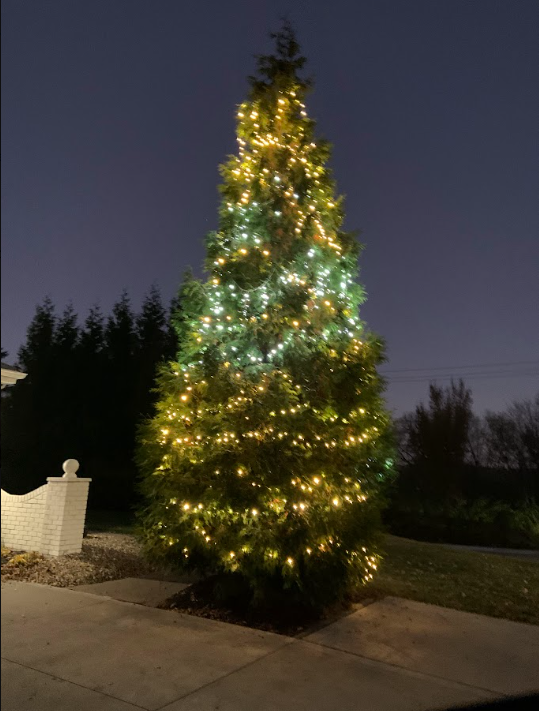
Tree trunk holiday lighting adds depth to a display that only lights the roofline, and it works on both evergreens and bare deciduous trunks with the right approach. The technique differs a bit between the two, since evergreens have branches and needles to work around while bare trunks need a wrap pattern that reads well without foliage.
Homeowners often try this themselves with mixed results, usually because of uneven spacing or lights that slide down the trunk after a wind storm. A little planning up front avoids both problems.
This post covers how to wrap trunks and evergreens for a full, even look, along with the mistakes we see most often.
Spiral wrapping a bare trunk
For a bare deciduous trunk, a spiral wrap using mini lights or micro LED strands gives the cleanest look. Start at the base, wrap at a consistent angle up the trunk, and secure the end near the first major branch rather than letting it dangle.
Consistent spacing between each wrap around the trunk matters more than cramming on extra lights. Wide, even spacing across a taller trunk usually looks better than tight spacing on just the lower few feet.
Leave a little slack rather than pulling the strand taut against the bark, since trunks can flex slightly in wind and a too-tight wrap is more prone to snapping a connection.
Wrapping evergreens differently than bare trunks
Evergreens have branches and needles that bare trunks do not, which changes the approach. Rather than only spiral wrapping the trunk, weave lights in and out along major branches so the light shows through the foliage rather than sitting entirely on the surface.
A common mistake is only lighting the outer tips of branches, which looks sparse and flat once it gets dark. Tucking strands slightly into the branch rather than just laying them across the top gives a fuller, more dimensional glow.
For taller evergreens, focus coverage on the lower two-thirds of the tree, which is what is actually visible from the street and where most of the visual impact happens.
Securing lights so they survive wind and snow
Lights that are not secured at both the base and the top of a wrap tend to slide down the trunk over the course of the season, especially after wind or heavy, wet snow. Anchoring points at both ends keep the wrap in place through typical Northwest Ohio winter weather.
For evergreens, lights woven into branches are naturally more secure than a loose wrap, but heavier wet snow can still shift a display that was not tied off at a few key points.
A quick check after any major storm is worth it, whether you installed the display yourself or had it professionally done, since even a well-secured wrap can shift over a full season.
- Anchor the start and end of any spiral wrap
- Weave rather than drape lights on evergreen branches for security and fullness
- Check displays after major wind or snow events
- Avoid pulling strands taut, since trees flex in wind
Bulb type and heat considerations
LED strands run cooler than incandescent bulbs, which is gentler on bark and needles over weeks of continuous or nightly use. The Ohio State University Extension publishes general seasonal outdoor care guidance that supports using lower-heat lighting options around living plant material where practical.
This is not usually a serious risk with typical holiday lighting durations, but it is a reasonable factor when deciding between incandescent and LED for trunk and branch wrapping specifically, since the lights sit in direct contact with the tree for weeks at a time.
LED also uses less energy over the display's nightly run time, which adds up if you are lighting several trees on the property.
Combining trunk lighting with the rest of your display
Trunk and evergreen lighting reads best as part of a layered display rather than as a standalone feature. Pairing it with roofline lighting creates depth between the house and the yard rather than one flat plane of light.
If you are also deciding between icicle lights and straight string lights for the roofline itself, our comparison guide breaks down which fits which roof style.
For a fuller landscape look year-round rather than just during the holidays, landscape lighting can highlight the same trees on a permanent basis.
Frequently asked questions
Does wrapping lights around a trunk damage the bark?
Not typically if the wrap has some slack and is not pulled taut. LED strands, which run cooler than incandescent, are a gentler choice for direct contact with bark over several weeks.
How do I keep lights from sliding down the trunk?
Anchor the start and end of the wrap securely rather than only relying on friction from the wrap itself, especially before wind or heavy snow events.
Should I light the whole height of a tall evergreen?
Focus on the lower two-thirds, which is what is most visible from the street and where the visual impact matters most.
Can you add tree and trunk lighting to an existing roofline display?
Yes, this is a common way to add depth to a display that currently only covers the roofline.
The bottom line
- Spiral wrapping suits bare trunks; weaving into branches suits evergreens.
- Even spacing matters more than total light count for a full look.
- Anchoring both ends of a wrap prevents sliding after storms.
- LED strands run cooler, which is gentler on bark and needles over the season.
- Trunk lighting pairs well with roofline lighting for a layered display.
Want your trees included in this year's display
We can add evergreen and trunk lighting alongside your roofline install for a fuller look.
Explore traditional lighting